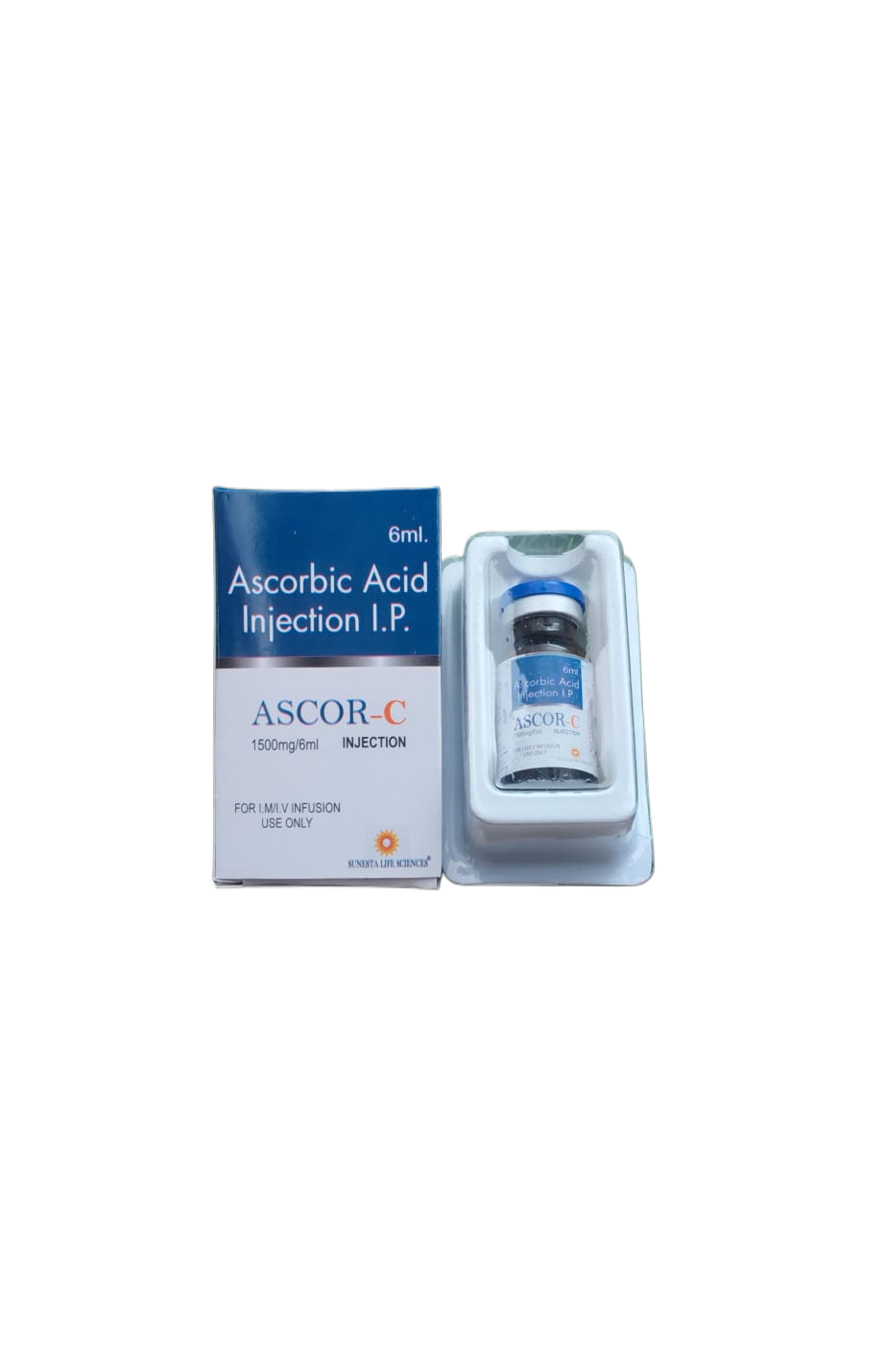
Ascorbic Acid (Vitamin C) is a water-soluble vitamin with potent antioxidant properties. It neutralizes free radicals, supports collagen synthesis (essential for wound healing), enhances iron absorption, and boosts immune cell function. Intravenous administration achieves much higher plasma levels than oral route, making it ideal for acute deficiencies, severe infections (adjunct in sepsis/COVID-19), post-surgical recovery, and oxidative stress conditions.
Antioxidant: Ascorbic acid donates electrons to neutralize reactive oxygen species (ROS), protecting cells from oxidative damage.
It also regenerates other antioxidants like vitamin E and glutathione.
Collagen synthesis: Acts as a cofactor for prolyl hydroxylase and lysyl hydroxylase, enzymes essential for collagen stabilization.
Critical for wound healing, bone formation, and vascular integrity.
Immune modulation: Enhances neutrophil, lymphocyte, and phagocyte function. Reduces duration and severity of respiratory infections.
Iron absorption: Reduces ferric iron (Fe³⁺) to ferrous iron (Fe²⁺), increasing gastrointestinal absorption.
Intravenous administration bypasses intestinal absorption limits, achieving plasma concentrations up to 10–20 times higher than oral.
| Active Ingredient | Ascorbic Acid (Vitamin C) – 500 mg or 1000 mg per 5 ml vial |
|---|---|
| Excipients | Sodium hydroxide (for pH adjustment), water for injection, sodium metabisulfite (antioxidant stabilizer). |
| pH Range | 5.5 – 7.0 |
| Osmolality | Approximately 300 mOsm/kg |
Vitamin C deficiency (scurvy): 500 mg once daily intravenously or intramuscularly for 7–14 days, then switch to oral.
Adjunct in severe infections (sepsis): 1–3 g per day intravenously divided every 6–8 hours (off-label, based on clinical protocols).
Post-surgical / wound healing: 500 mg to 1 g daily intravenously for 3–7 days.
Burns: Up to 1 g daily IV for 10–14 days.
For IV use: Dilute in 50–100 ml of normal saline or 5% dextrose. Infuse over 30–60 minutes to minimize adverse effects.
For IM use: Inject deeply into large muscle mass (gluteal or deltoid). Do not exceed 1 g per IM injection site.
Avoid rapid IV push (risk of dizziness, faintness, and phlebitis). Monitor renal function in high-dose therapy.
| Dosage Form | Sterile, clear to slightly yellowish solution in glass vial |
|---|---|
| Available Strengths | 500 mg/5 ml, 1 g/10 ml (each in single-dose vial) |
| Packaging | 10 vials per carton (blister pack or individual cartons) |
| Manufacturing Standard | WHO-GMP, ISO 13485 (sterile injectables) |
| Shelf Life | 24 months from date of manufacture |
| Country of Origin | India |
| Minimum Order Qty | 500 vials (mix of strengths as per order) |
Common side effects (usually mild and dose-dependent):
Oxalate nephropathy: High-dose vitamin C (>1 g/day) can be metabolized to oxalate, causing kidney stones or acute kidney injury
in susceptible individuals (renal impairment, hyperoxaluria). Monitor urine oxalate in long-term high-dose therapy.
Hemolysis: Risk in patients with G6PD deficiency (avoid high doses).
Iron overload: Caution in hemochromatosis or thalassemia (vitamin C increases iron absorption).
Store below 25°C (77°F), protected from light. Do not freeze. Do not store in direct sunlight.
Once opened, use immediately. Discard any unused portion. Do not use if solution is discolored or contains particles.
Full export docs: COA, Stability data, GMP certificate, FSC, MSDS, commercial invoice. Cold chain not required, but protect from extreme heat (>40°C).