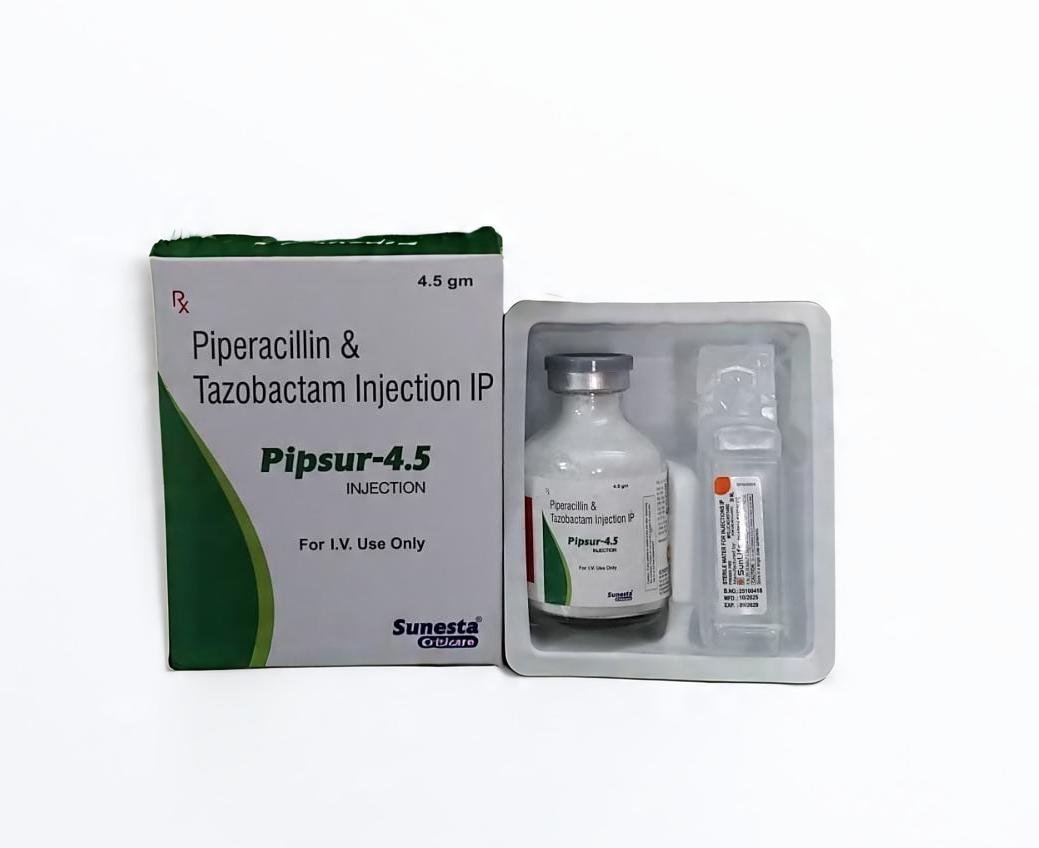
Piperacillin is a broad-spectrum ureidopenicillin active against Gram-positive, Gram-negative, and anaerobic bacteria. Tazobactam is a beta-lactamase inhibitor that protects piperacillin from degradation by common resistance enzymes (TEM, SHV, CTX-M, AmpC). This combination provides potent activity against hospital-acquired infections including pneumonia, complicated urinary tract infections (cUTI), intra-abdominal infections, sepsis, and febrile neutropenia. Effective against Pseudomonas aeruginosa, Klebsiella pneumoniae, E. coli, and Bacteroides fragilis.
Piperacillin: Inhibits bacterial cell wall synthesis by binding to penicillin-binding proteins (PBPs),
disrupting peptidoglycan cross-linking, leading to bacterial lysis (time-dependent killing).
Tazobactam: A beta-lactamase inhibitor with a beta-lactam ring that irreversibly binds to and inactivates
many plasmid-mediated and chromosomally-mediated beta-lactamases (class A and some class C). It does not have significant
intrinsic antibacterial activity but protects piperacillin from hydrolysis.
Spectrum of activity: Gram-positive (Streptococcus spp., MSSA, Enterococcus faecalis),
Gram-negative (Pseudomonas aeruginosa, Klebsiella spp., E. coli, Proteus, Morganella, Serratia, Citrobacter,
Acinetobacter (variable), Haemophilus influenzae, Moraxella catarrhalis), Anaerobes (Bacteroides fragilis group,
Clostridium, Peptostreptococcus).
Not active against MRSA, ESBL-producing Enterobacteriaceae (if ESBL is not inhibited by tazobactam – variable),
carbapenemase-producing organisms (KPC, NDM, VIM), or Stenotrophomonas maltophilia.
| Active Ingredients (per vial) | Piperacillin Sodium IP equivalent to Piperacillin 4 g + Tazobactam Sodium IP equivalent to Tazobactam 0.5 g (ratio 8:1) |
|---|---|
| Excipients | None (sterile lyophilized powder; no added preservatives) |
| pH (reconstituted) | 6.0 – 8.0 | Osmolality (reconstituted) | Approximately 300 mOsm/kg |
Hospital-acquired pneumonia (HAP): 4.5 g IV every 6 hours for 7–14 days.
Complicated intra-abdominal infections: 4.5 g IV every 8 hours (plus metronidazole if needed) for 5–14 days.
Complicated urinary tract infections (cUTI): 4.5 g IV every 8 hours for 7–14 days.
Febrile neutropenia: 4.5 g IV every 6 hours (in combination with an aminoglycoside) until resolution.
Diabetic foot infections (moderate to severe): 4.5 g IV every 8 hours for 7–28 days.
Sepsis (empiric): 4.5 g IV every 6–8 hours, adjust based on culture results.
CrCl 20–40 mL/min: 4.5 g IV every 8 hours.
CrCl <20 mL/min (including hemodialysis): 4.5 g IV every 12 hours.
Hemodialysis patients: Give after dialysis session (supplemental dose of 2.25 g after each session).
Reconstitute each 4.5 g vial with 20 ml of sterile water for injection, normal saline, or 5% dextrose. Shake gently to dissolve. For IV infusion: further dilute reconstituted solution in 50–150 ml of compatible fluid (NS, D5W, LR) and infuse over 30 minutes. For IM injection (less common): reconstitute with 10 ml of sterile water for injection and inject deeply into large muscle. Use within 24 hours if stored at 2–8°C after reconstitution; discard unused portion.
| Dosage Form | Sterile lyophilized white to off-white powder in glass vial |
|---|---|
| Strength | 4 g piperacillin + 0.5 g tazobactam per vial (4.5g) |
| Packaging | 1 vial per carton (with or without diluent), 10 cartons per box |
| Manufacturing Standard | WHO-GMP, ISO 13485 (sterile injectables) |
| Shelf Life | 24 months from date of manufacture (lyophilized) |
| Country of Origin | India |
| Minimum Order Qty | 500 vials (500 cartons) |
Common side effects (occurring in 1-10% of patients):
Clostridioides difficile-associated diarrhea (CDAD): May occur during or up to 2 months after therapy.
Hypersensitivity reactions: Rash, urticaria, anaphylaxis (cross-reactivity with penicillins, cephalosporins).
Hematologic effects: Leukopenia, neutropenia, thrombocytopenia (reversible).
Hepatotoxicity: Elevated liver enzymes, hepatitis (rare).
Renal effects: Interstitial nephritis, acute kidney injury (rare).
Neurotoxicity: Seizures (high doses, especially in renal impairment).
Electrolyte disturbances: Hypokalemia (due to piperacillin).
Store below 25°C (77°F), protected from light. Do not freeze.
Room temperature (25°C): stable for 24 hours. Refrigerated (2-8°C): stable for 48 hours. Discard unused portion.
Full export docs: COA, Stability data, GMP certificate, FSC, MSDS, commercial invoice. Cold chain not required, but protect from extreme heat (>40°C).